
Electricity is one of the biggest running costs on a poultry farm, and it rarely lets up. Unlike a house, where usage rises and falls through the day, a poultry shed pulls power almost around the clock.
The good news is that most of that spend comes from just two systems, and both can be made noticeably more efficient without touching flock welfare.
Where the Electricity Actually Goes
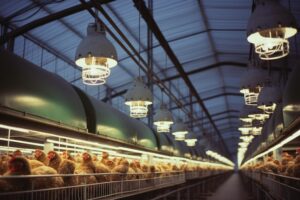
On most sheds, lighting and ventilation between them account for the bulk of the electricity bill. Everything else — feed systems, water, office equipment — tends to be small by comparison.
- Lighting runs for set photoperiods, often many hours a day, across every house on site
- Ventilation fans run almost continuously to manage temperature, humidity and air quality
- Both systems scale with the number of houses, so savings on one house repeat many times over on a larger site
Lighting in Poultry Houses: Where the Easy Wins Are
Older fluorescent or incandescent fittings burn through electricity fast, and they also degrade faster in the dust and damp of a working shed.
Swapping to LED fixtures is usually the single biggest, quickest win available.
Dimmable, poultry-specific fittings also make it easier to manage lighting programmes precisely, rather than running everything at full brightness regardless of what the flock actually needs at that stage.
Why Ventilation Costs Add Up Just as Fast
Fans running continuously, day and night, mean even a modest efficiency gain per unit adds up quickly across a whole shed. A well-planned poultry farm ventilation installation makes that saving easier to achieve without sacrificing air quality.
Variable-speed drives and better motor efficiency can cut ventilation running costs noticeably, without changing the amount of fresh air moving through the shed. Poorly maintained or oversized fans are a common, avoidable source of wasted electricity.
Getting the Right Setup for Your Farm
Farms looking for poultry house lighting installation services Yorkshire providers offer should expect more than a straight swap of old fixtures for new ones. A proper assessment looks at shed size, current usage, and how lighting and ventilation interact.
The best poultry house lighting installation services Yorkshire farms use also factor in dust, damp and daily wear, since fittings rated for a normal building rarely last in a working shed environment.
Practical Steps to Cut Costs Without Cutting Corners
- Get a proper assessment of current lighting and ventilation usage before changing anything.
- Prioritise LED lighting first, since it’s usually the fastest payback.
- Look at variable-speed control for ventilation fans rather than replacing like-for-like.
- Keep a maintenance schedule, since dirty or worn equipment quietly uses more power.
- Review usage again after changes to confirm the savings are actually showing up.
Why Choose Lawson Electrical Ltd
Lawson Electrical Ltd works with poultry farms across Yorkshire on both lighting and ventilation, so recommendations account for how the two systems affect each other rather than treating them separately.
Want to know where your farm could save? Get in touch with Lawson Electrical Ltd.